
01 / PRE-PRODUCTION AND LOCATION SCOUTING · LISBON, THE DAY BEFORE THE SHOOT
The day before we were due to start filming in Lisbon and welcome the clients, the local runner arrived. He didn’t have a driving licence, which was essential for the job.
It had all started in pre-production. Our usual runner was busy and put us in touch with someone he knew, who was also booked for those dates and referred us to a third person. We went from one contact to the next until someone said yes. It was like a game of telephone: by the time the information reached the last person in the chain, it had been completely distorted. It wasn’t his fault: the message got lost along the way.
And in all likelihood, there was a runner in Lisbon with a driving licence who was free on those very dates. We didn’t know he existed, and he didn’t know we needed him.
“The same need on both sides, yet they never find each other.”
That’s just one example: every project brings surprises that send you looking. I’ve spent 25 years working in audiovisual production across half the world, and I still find it a fascinating profession. In the end, it’s the people who make it all work. Over the years we’ve built a wide network, but every network has its limits: when you’re filming somewhere new, the script calls for someone with a very specific skill, or someone you trust lets you down just hours before the shoot, you have to look beyond it.
And that’s when the familiar ritual begins.
“Do you know someone who knows someone?”
We ask that question ourselves, and colleagues ask us when they’re looking for recommendations in cities where we’ve worked. We end up running a switchboard for favours. A good recommendation is worth its weight in gold, and word of mouth will always be around. What surprises me is that in an industry with cutting-edge technology, finding and vetting talent is still such a hands-on process.
About ten years ago I began imagining a kind of TripAdvisor for professionals. If I could look up a hotel in Tokyo, compare options and read reviews in minutes, why couldn’t I do the same for a sound technician, a make-up artist or a location scout?
A search tool helps you find someone when you don’t know whom to call. It also lets you check out someone who’s been recommended to you. If someone recommends a restaurant, I usually look it up to see what it’s like, what it serves and what other people think. In Lisbon, if we’d been able to see that third contact’s profile, his details and genuine reviews when we got his name, we’d have had a lot more information before committing to anything.
For years I looked for something like that without finding it. Platforms that charged commission left out many professionals who didn’t want to cut their rates or depend on middlemen. If you only see the people who accept those terms, your search is limited from the start. Traditional directories and networks, on the other hand, show you CVs, but leave out what matters when you spend twelve hours on set together: how that person handles the actual job.

The talent that never turns up in a search
We also had to look at the other side: people who do excellent work but are barely visible outside their usual circles, whether they’re based in a small town, work for regular clients or are just starting out. Being good at your job and getting found shouldn’t be two separate jobs.
When we decided to stop waiting for someone else to build it and do it ourselves, we started with one clear principle: having a profile has to be free. If you have to pay or give up part of your fee to be listed, you never see the whole picture. With free profiles, a technician in a small town can show up just like someone who’s spent years on major productions.
While we’re at it… why not kill two birds with one stone?
As the search tool took shape, another familiar production challenge came up: organising the crew once everyone’s on board.
It’s Wednesday and the shoot is tomorrow. The production team sets up WhatsApp groups by department, the client emails a file, someone shares photos on WhatsApp and someone else sends a WeTransfer link. Meanwhile, a technician has three call sheets in three different places and asks “Is this the right one?” in a group of forty people, where the message gets lost.
Then come the familiar questions: “Where did you send it?”, “I don’t have it” or “Could you send it again?”. And there’s the hassle of filling your phone with one-off contacts while your personal number keeps circulating among crews from past shoots.
That’s why we decided to add an internal chat and a workspace for each project, keeping conversations, files and information in one place without exchanging personal phone numbers or chasing documents across half a dozen apps.
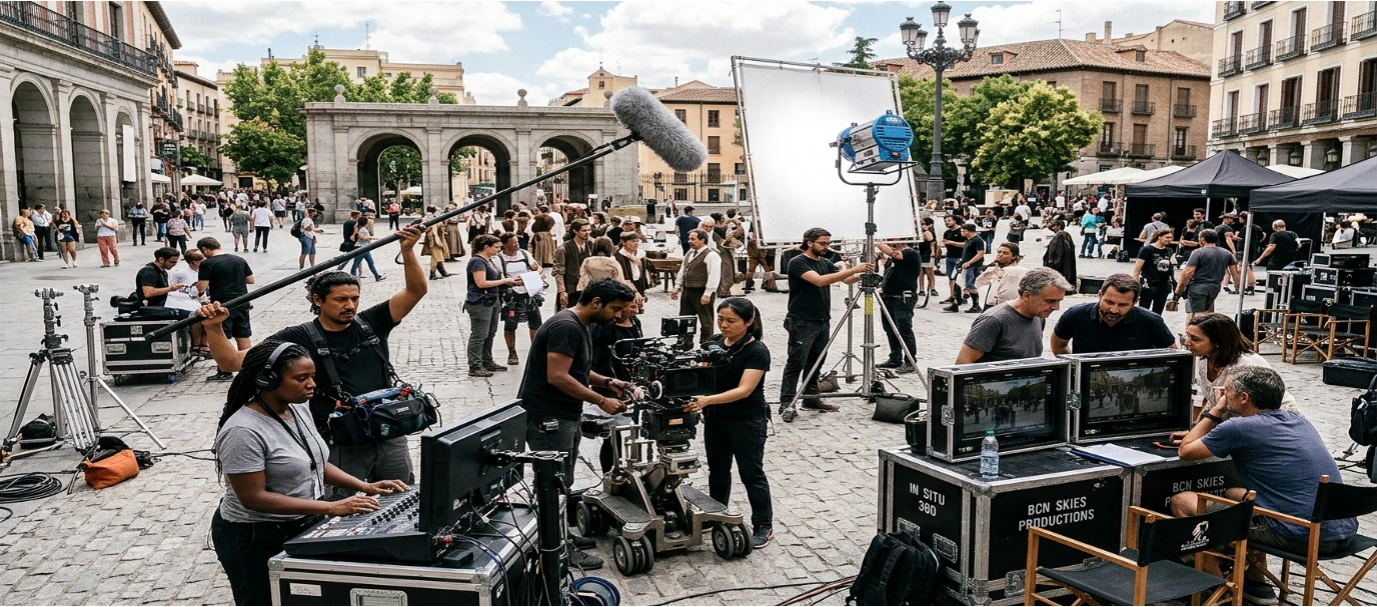
And that’s how IN SITU 360 was born
What began as a need of our own grew into a broader project, both for people looking for someone and for those who want to get their name out there. From my conversations with people who work on concerts, theatre, events or private celebrations, it’s clear how widely this problem is shared.
The talent is there, and so is the enthusiasm. What’s missing is a simple way to connect.
“Talent shouldn’t depend on whose number you have saved on your phone.”
After ten years of waiting for someone to come up with this idea, at least I won’t have to keep asking myself: what if it works?
Susana Vilallonga
CEO · BCN Skies Productions · Founder · IN SITU 360